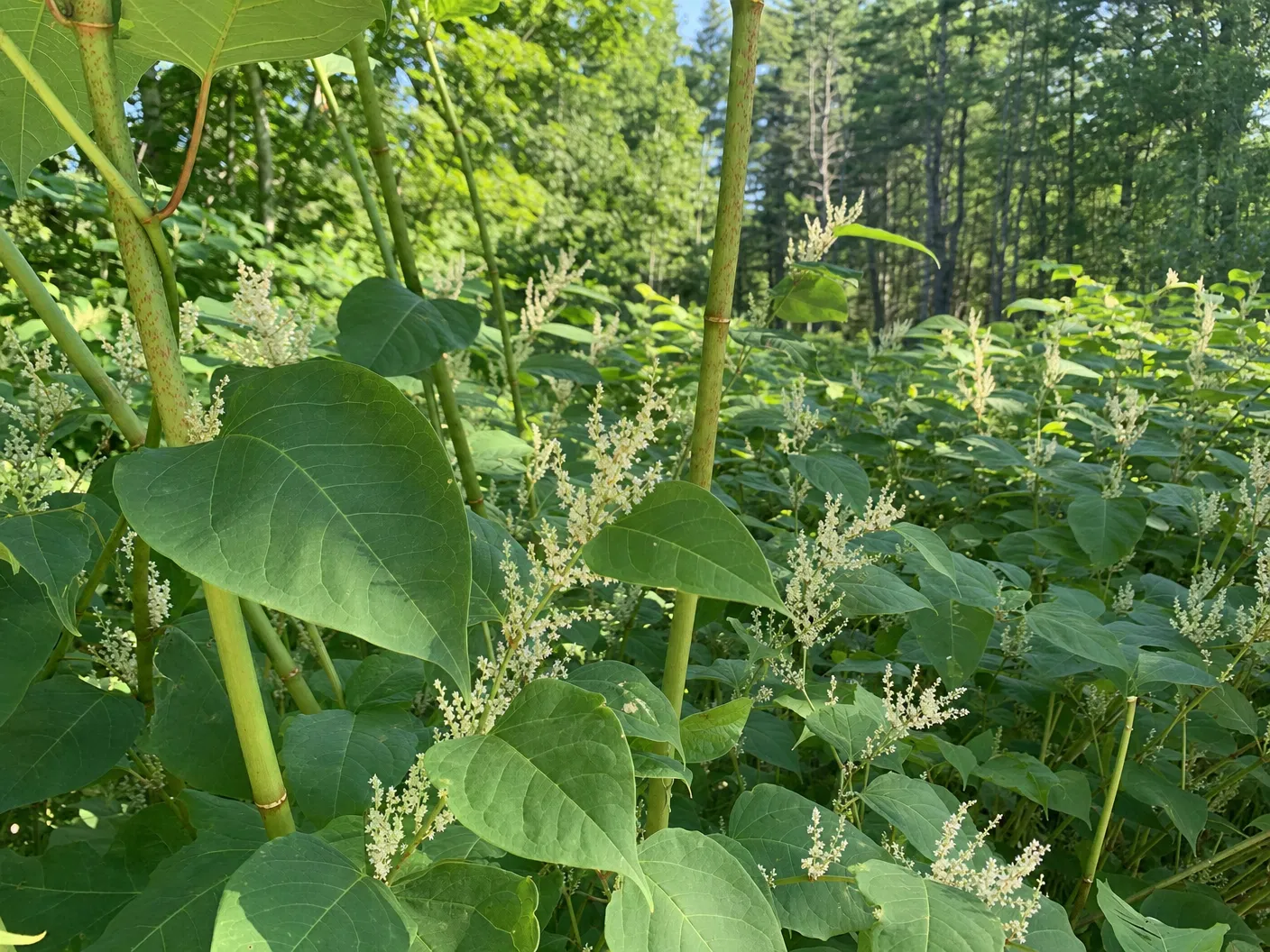
Japanese knotweed is one of the most aggressive and destructive invasive plants in Maine. Originally introduced as an ornamental in the late 1800s, it has spread throughout Southern Maine's riverbanks, roadsides, and residential properties. If you have knotweed on your property, you already know it grows fast, spreads relentlessly, and resists almost everything you throw at it. This guide explains how to identify it, why it matters, and the most effective removal method available in Southern Maine.
How to Identify Japanese Knotweed in Maine
Japanese knotweed (Fallopia japonica) is often mistaken for bamboo because of its hollow, segmented stems. Here is how to positively identify it on your property:
Key Identification Features
- Stems: Hollow, bamboo-like, green with reddish-purple speckles. Grow up to 10 feet tall in a single season. Dead stalks persist through winter as brown-red canes.
- Leaves: Heart-shaped (or shield-shaped), approximately 6 inches long with pointed tips. Arranged alternately on the stem in a distinctive zig-zag pattern.
- Flowers: Small, creamy-white clusters appear in late August through September along the upper stems.
- Root system: Extensive underground rhizome network that can extend 10 to 30 feet laterally from the visible plant and reach 10 feet deep.
- Growth rate: Can grow up to 4 inches per day during peak season (May through July).
Knotweed is commonly found along the Saco River, Presumpscot River, and throughout Portland, Scarborough, Biddeford, and Westbrook. It thrives in disturbed areas, riverbanks, roadsides, and the edges of residential properties. If you see dense stands of bamboo-like plants anywhere in Southern Maine, it is almost certainly Japanese knotweed.
Why Japanese Knotweed Is a Serious Problem
Knotweed is not just an aesthetic nuisance. It causes real, measurable damage to properties and ecosystems across Southern Maine:
Property Damage
Knotweed rhizomes can crack foundations, damage retaining walls, invade septic systems, and push through asphalt driveways. The plant exploits any crack or weakness in man-made structures. In the UK, mortgage lenders routinely deny financing for properties with knotweed infestations. This trend is growing in the Northeast United States, and home inspectors in Maine increasingly flag knotweed during pre-sale inspections. A visible knotweed infestation can reduce property value by 10% or more and kill a home sale outright.
Ecological Damage
Knotweed forms dense monocultures that shade out all native plants. Along riverbanks, it displaces native vegetation that stabilizes soil, leading to increased erosion and degraded water quality. It provides almost no food value for native wildlife. Once established, it dominates the landscape and eliminates biodiversity.
Spread Mechanism
Knotweed spreads primarily through its rhizome network, but also through stem fragments. A piece of stem as small as half an inch can root and establish a new colony. This means that improper cutting, mowing, or disposal can actually spread the plant to new areas. Moving soil that contains rhizome fragments is one of the most common ways knotweed colonizes new properties in Southern Maine.
Why DIY Knotweed Removal Fails
Most homeowners try cutting, mowing, or pulling knotweed before calling a professional. Here is why these methods fail:
Cutting or mowing removes above-ground growth but does nothing to the underground rhizome network. The plant simply regrows from stored energy in the roots. Worse, cut stem fragments can root in new locations, spreading the infestation. You can mow knotweed every week for years and it will keep coming back.
Pulling by hand is impossible for established knotweed. The rhizomes extend up to 30 feet laterally and 10 feet deep. You cannot physically remove the entire root system by hand. Any rhizome fragment left in the soil will regenerate.
Herbicide spraying requires multiple applications over 3 to 5 years with glyphosate-based products. Results are slow, inconsistent, and leave chemical residue in your soil and potentially in nearby waterways. Many homeowners in Portland and Scarborough are uncomfortable spraying herbicides near their wells, gardens, and children's play areas.
How Forestry Mulching Removes Knotweed
Forestry mulching is the most effective mechanical method for knotweed removal. Our equipment grinds the dense above-ground growth into fine mulch in a single pass. This is significantly faster and more aggressive than hand-cutting or mowing.
The mulched material stays on the ground as a suppression layer, blocking sunlight from reaching any remaining root crowns. For established infestations, we recommend a multi-pass approach: an initial heavy mulching followed by one or two follow-up passes during the growing season. Each pass exhausts more energy from the rhizome network until it can no longer sustain regrowth.
What takes a crew with hand tools weeks to accomplish, our equipment does in hours. A typical residential knotweed stand that covers a quarter acre can be mulched in a single morning. No chemicals. No hauling debris off-site. No risk of spreading fragments to new areas because everything is processed in place.
When to Remove Knotweed in Maine
The best time for initial knotweed mulching is late spring through early summer (May through July) when the plant is actively growing and investing energy in above-ground stems. Removing this growth at peak season forces the rhizome to deplete its energy reserves faster. Follow-up passes are most effective in late summer (August through September) when the plant is preparing for dormancy.
If you are selling your home, schedule removal as early as possible. Repeated treatments produce the best visual results, and having a documented removal history can reassure buyers and their inspectors.
Have Knotweed on Your Property?
Call (207) 819-8660 for a free on-site assessment. We will identify the species, assess the extent of the infestation, and give you an honest quote the same day. Serving Portland, Scarborough, Biddeford, Saco, and all of Southern Maine.
